Čeština
 English
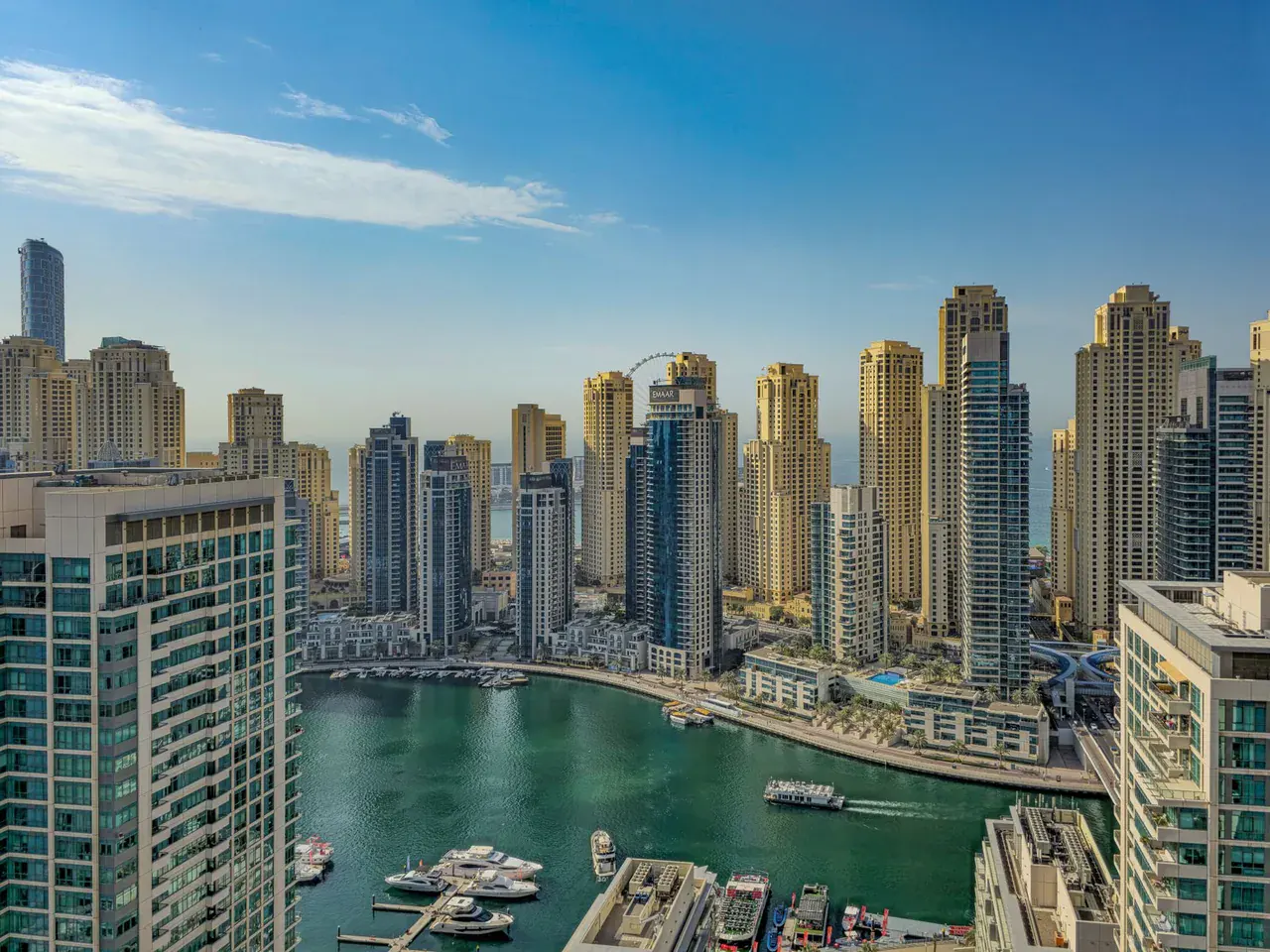
This article is about long-term rentals, meaning annual tenancy contracts. In Dubai that is a completely different world from the nightly stays most visitors know from holidays: a different price, different rules and different obligations for the landlord. In the first half of 2026, average annual rents for apartments in the areas in our table ranged from around 60,000 AED in International City to 284,000 AED on Palm Jumeirah, and by size from 41,000 AED for a studio to 382,000 AED for a three-bedroom apartment. Below you will find what Dubai rent prices look like today by area and size, what you pay on top of the rent and which rules apply when a contract is renewed.
We write for both sides. For anyone looking for a home in Dubai for a year, and for owners who let their unit remotely and are wondering whether to move it from short-term rentals to an annual contract and have peace of mind.
Table of Contents
Long-term rental versus nightly stays: why not to mix them up
An annual lease and a short-term rental are two different products, and this text covers only the first one. The difference matters:
- A long-term rental means an annual contract registered in the Ejari system, a tenant with a residence visa, payment usually by several cheques in advance and protection under Dubai's tenancy law, including caps on rent increases. The landlord gets a stable return with minimal effort, but the unit is committed for the whole year.
- A short-term rental (holiday home) is priced per night, requires a permit from Dubai's Department of Economy and Tourism (DET, formerly DTCM) and ongoing operation: cleaning, check-ins, seasonal pricing. It earns more when occupancy is good, but it is a business, not passive income.
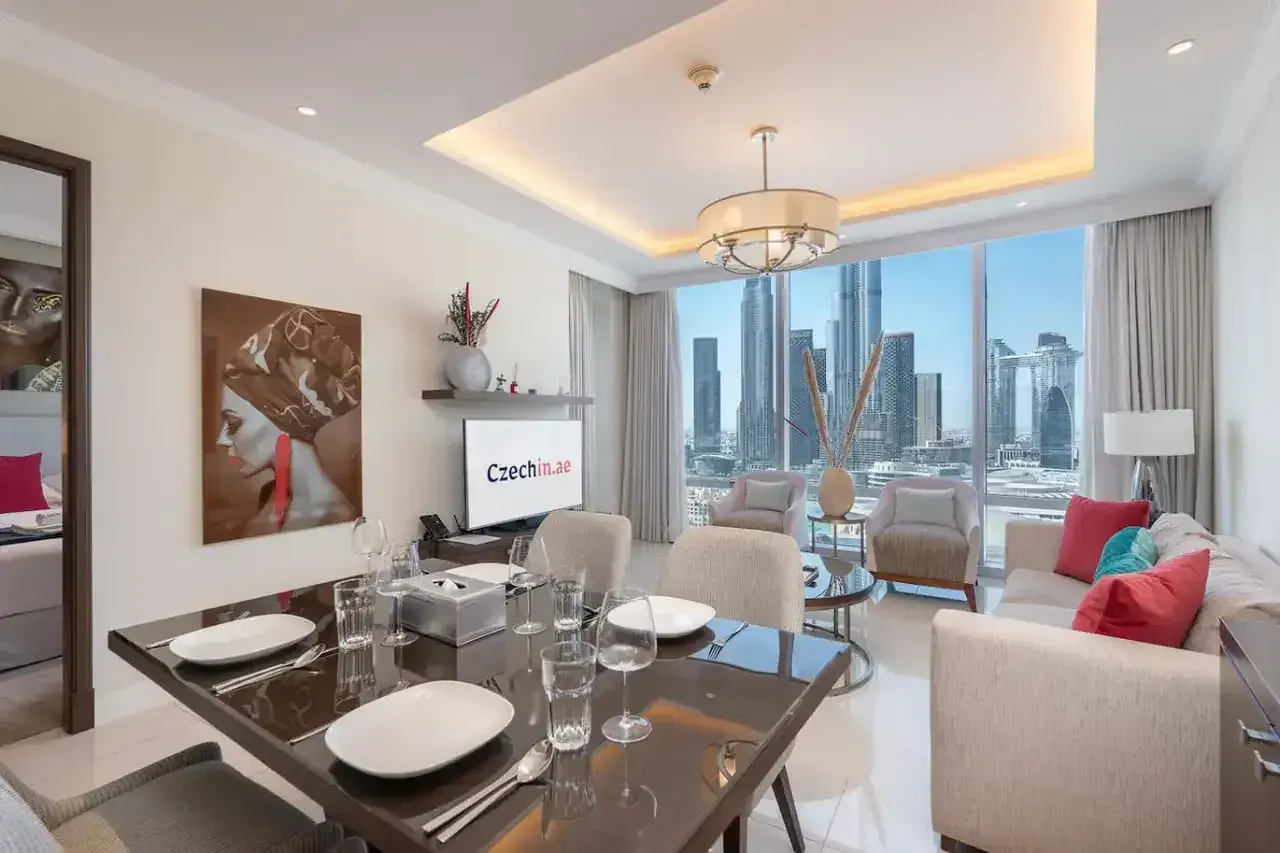
We do both, and we look at the difference in detail in our article on short-term and long-term rentals. The tables below describe annual contracts only. Our furnished one-bedroom apartment in Jewels Tower in Dubai Marina, on the other hand, is an example of the short-term model with a nightly price, so it cannot be compared with the figures in the tables.
How much does a long-term apartment rental in Dubai cost by area?
According to Bayut's report for the first half of 2026, the average advertised annual rent for an apartment in the areas in our table ranges from around 60,000 AED in International City to 284,000 AED on Palm Jumeirah, almost five times as much. The most expensive apartment address in the whole report is Bluewaters Island, with an average of 467,000 AED.
A note on terms: Dubai listings count bedrooms, not rooms. A one-bedroom apartment is what Czech and Slovak listings call a 2+kk.
| Area | Studio | 1 bedroom | 2 bedrooms | 3 bedrooms | Area average |
|---|---|---|---|---|---|
| Palm Jumeirah | not given | 169,000 AED | 249,000 AED | 382,000 AED | 284,000 AED |
| Downtown Dubai | not given | 133,000 AED | 223,000 AED | 362,000 AED | 226,000 AED |
| Dubai Marina | not given | 103,000 AED | 157,000 AED | 249,000 AED | 153,000 AED |
| Business Bay | 73,000 AED | 104,000 AED | 148,000 AED | not given | 118,000 AED |
| Arjan | 53,000 AED | 79,000 AED | 116,000 AED | not given | 89,000 AED |
| JVC (Jumeirah Village Circle) | 54,000 AED | 79,000 AED | 113,000 AED | not given | 81,000 AED |
| International City | 41,000 AED | 61,000 AED | 82,000 AED | not given | 60,000 AED |
Data as of: first half of 2026 (January to June 2026). Source: Bayut, Dubai Rental Market Report H1 2026, published 15 July 2026, updated 28 July 2026. Annual rents in dirhams (AED). These are averages of advertised prices, not signed contracts, and the rent actually agreed tends to be lower. The half-year average also includes March to June 2026, which were distorted by the regional conflict.
How much does it cost to rent a villa or house in Dubai long term?
In the first half of 2026, the average annual villa rent in the areas in our table started at around 120,000 AED in DAMAC Hills 2 and ended at 1,738,000 AED on Palm Jumeirah, which is also the most expensive address in the whole report. A villa in DAMAC Hills 2 therefore costs less than the average apartment in Dubai Marina.
| Area | Villa average | Of which 4 bedrooms |
|---|---|---|
| Palm Jumeirah | 1,738,000 AED | 1,381,000 AED |
| Dubai Hills Estate | 654,000 AED | 359,000 AED |
| Arabian Ranches | 411,000 AED | 404,000 AED |
| Dubai South | 172,000 AED | 191,000 AED |
| Mirdif | 159,000 AED | 166,000 AED |
| DAMAC Hills 2 | 120,000 AED | 124,000 AED |
Data as of: first half of 2026, including March to June 2026, which were distorted by the regional conflict. Source: Bayut, Dubai Rental Market Report H1 2026. Note that DAMAC Hills 2 (formerly Akoya Oxygen) is a different community from DAMAC Hills, where the report gives an average villa rent of 263,000 AED, more than double. The name "Akoya" alone is not enough to tell them apart, as Bayut uses it in listings for both. In the cheaper communities a four-bedroom villa is above the average, in the more expensive ones below it: there the average is pulled up by larger houses.
For a landlord, the same row is a ceiling, not a target: advertised averages get negotiated down, and every month a unit stands empty costs a twelfth of the annual rent, or 8.3 percent.
Dubai rent prices in 2026: up or down?
In the second quarter of 2026 rents turned downwards: according to the CBRE report for Q2 2026, by 6.2% on average compared with the previous quarter and by 2.6% year on year. That this is the first reversal in years is reported by The National. It is not an across-the-board fall, though. The REIDIN rental index, which CBRE uses for Dubai, fell by 2.55% year on year in June 2026, but the trend differs between areas: Bayut reports growth of 5.31% for apartments on Palm Jumeirah in the first half of 2026, yet does not state the comparison period for that figure, and elsewhere in the report describes the same number as growth in demand, not in rents.
According to CBRE, the market turned at the beginning of March 2026 and the conflict was still going on at the end of June. The whole second quarter falls within that period, so treat both the year-on-year and the quarter-on-quarter comparisons for it with caution.
According to research by Cavendish Maxwell, published by The National, negotiating power has shifted to tenants for the first time in years. In the three months to May 2026 rents fell by 1.1%, most for villas and townhouses (2.1%) and by 0.9% for apartments. Compared with May 2025 they are, according to the same source, still about 9% higher, and here the sources contradict each other: CBRE reports 2.6% down year on year and REIDIN 2.55% down for June. The difference is not in the decimals but in the sign, because each index measures a different basket of properties and a different time window. Both confirm the quarter-on-quarter reversal, the year-on-year direction they do not, so for now take only the short-term trend. Cavendish Maxwell gives the gross yield in a newer report for the first half of 2026, published in Khaleej Times: as of June 2026 it stood at 6.9% for apartments and 5.0% for villas and townhouses, before fees and management. Note that the same report measures rents differently from CBRE. According to it, the average rent rose to 75.7 AED per square foot per year as of June 2026, which is 7.8% up year on year. The difference lies in the methodology, not in the reality of a single market.
Why is long-term rent in Dubai paid annually, and what are the cheques?
Because Dubai's long-term rental market is quoted annually, not monthly: the landlord wants the whole year covered in advance, and the tenant provides this with a set of post-dated cheques, meaning cheques signed when the contract is signed but payable on agreed dates during the year. According to the government portal u.ae, rent can be paid in one payment or in instalments. The parties agree the number of cheques freely, and the law only steps in as a fallback: Article 12 of Law No. 26 of 2007 provides that if the parties do not agree on the payment dates, the rent is paid in four equal instalments. Otherwise market logic applies: the fewer cheques, the better the price, because the landlord carries less risk.
How much money do I need on top of the first rent?
For an apartment at 90,000 AED a year, count on roughly 11,600 AED extra when signing, of which about 6,500 AED are refundable deposits and 5,100 AED non-refundable fees and commission. Specifically, this covers Ejari registration, the DEWA deposit and fees, the five percent municipal housing fee and the agent's commission. Only the government part is regulated, the rest is contractual custom. We give the amounts according to price lists and practice verified as of August 2026.
- Ejari, contract registration: 177.75 AED online, 220 AED at a trustee centre, according to the Dubai Land Department fee schedule. According to the u.ae portal the landlord is responsible for registration, but in practice the tenant often pays the fee, and at a trustee centre it is the tenant who applies. Without Ejari you cannot connect DEWA.
- DEWA, electricity and water: a refundable deposit of 2,000 AED for an apartment and 4,000 AED for a villa. Activation costs 125 AED for small meters and 300 AED for large ones, plus three fees of ten dirhams each (registration, knowledge and innovation fee), so 155 AED in total for an apartment. The fees are listed by DEWA, page last updated 1 January 2026.
- Housing fee 5%: a municipal fee of 5% of the annual rent, spread across the monthly DEWA bills. Source: u.ae.
- Agent's commission: no Dubai regulation sets the rate, it follows the brokerage agreement. The u.ae portal mentions a commission of up to 5% of the rent, and the market custom in Dubai is 5% of the annual rent plus VAT on signing. According to a statement by the Rental Disputes Center from February 2020, no commission should be charged on renewal, although the authority itself adds that the law has no clear provision on this.
- Security deposit to the landlord: Law No. 26 of 2007 allows it in Article 20 but does not set the amount. The usual 5% for an unfurnished and 10% for a furnished apartment is market custom, not regulation.
- Cooling and service charges: for units connected to district cooling, the bill also has a fixed component (capacity charge), which you pay even with zero consumption. This does not apply everywhere, as Dubai's regulator RSB has limited this component for some types of systems since September 2025. Who pays it must be stated in the contract. Under an interpretation from January 2020 of Law No. 6 of 2019, the building's service charges are paid by the owner unless the contract says otherwise. They can be passed on to the tenant by contract, but this does not release the owner from liability towards the building management: if the tenant does not pay, the debt stays with the unit.
Breakdown of the upfront costs for an apartment at 90,000 AED: Ejari 177.75 AED, DEWA activation 155 AED, commission 4,500 AED plus VAT of 225 AED, and on top of that refundable deposits of 2,000 AED to DEWA and 4,500 AED to the landlord. The housing fee of 4,500 AED is paid separately, spread across the monthly DEWA bills.
How much can my rent be increased when the contract is renewed?
By 20% at most, and only if your rent is more than 40% below the market average. If the difference is 10% or less, it cannot be increased at all. The caps apply only to the renewal of an existing contract; for the first contract you agree the rent freely according to the market. The exact bands are set by Decree No. 43 of 2013:
- up to 10% below the average: no increase possible,
- 11 to 20% below the average: up to 5%,
- 21 to 30% below the average: up to 10%,
- 31 to 40% below the average: up to 15%,
- more than 40% below the average: up to 20%.
This is not new in 2026, the percentages have applied unchanged since 18 December 2013. For a landlord it is a cap, not an entitlement: the party that wants a change must give notice at least 90 days before the contract expires under Article 14 of Law No. 26 of 2007 as amended by Law No. 33 of 2008, and a different period can be agreed. Whoever misses it cannot push the change through for the next term, and the contract continues on the existing terms, even if the DLD calculator would allow an increase. If the contract expires and the tenant stays in the apartment without the landlord objecting, it renews itself on the same terms under Article 6 of the same law. If the landlord wants the tenant to leave at the end of the contract, for example because of a sale, own use, demolition or major renovation, the landlord must give notice through a notary or by registered mail at least 12 months before the eviction date, not before the end of the contract. For own use, the landlord must also show that they have no other suitable property. During the contract the law allows eviction earlier, for unpaid rent 30 days after the notice is served. If the parties cannot agree, the Rental Dispute Settlement Centre at the Dubai Land Department decides, a special court for tenancy disputes only. It goes by the wording of the contract, the Ejari record and the date of notice, not by verbal agreements.
The market average for your area and unit size, and the permitted increase, are calculated by the DLD rental index calculator, which also takes into account the building rating from the Smart Rental Index launched on 2 January 2025. According to reports from the index launch, it is a rating of one to five stars, definitely not grades A to D, as real estate blogs sometimes claim. The stars do not set the permitted percentage, they only affect how the average is calculated. Note that the tables above and this average are two different figures: the tables show advertised prices from Bayut, whereas the cap on increases is calculated from the average the DLD calculator returns for your building. A listing on its own has no legal weight. How the index is put together and what the stars mean is explained in our guide to the rental index.
How to use the table: tenant and landlord
You are looking for a place to live in Dubai for a year
Choose a row by budget and add the upfront costs from the section above. The prices are advertised ones, and there is real room to negotiate. We can shortlist units for an annual contract to fit your needs, just write to us. If, on the other hand, you are looking for a stay of days or weeks, our holiday apartments are for you, and the whole nightly model is summed up on the apartment rentals in Dubai page.
You own an apartment in Dubai and are considering an annual lease instead of nightly stays
Read the same table the other way round: the row for your area and size is the upper limit of what the market will bear today. A one-bedroom apartment in JVC at 79,000 AED a year corresponds, at the citywide gross yield of 6.9% reported by Cavendish Maxwell as of June 2026, to a purchase price of around 1,150,000 AED. Every empty month takes 6,583 AED off the annual rent, whereas a 5% discount for a faster signing costs 3,950 AED, roughly three fifths of that. With rents falling, the speed of letting therefore matters more than the advertised price.
An annual contract usually earns less than a well occupied short-term rental, but it is one decision a year instead of operating every week: no key handovers, cleaning, seasonal pricing or swings in occupancy. For an owner based in the Czech Republic, Slovakia or elsewhere in Europe who does not want to deal with their Dubai unit every day, it is the most relaxed option. How the three most sought-after addresses differ in tenant profile and demand is covered in our comparison of Dubai Marina, JBR and Downtown.
Frequently asked questions
How much does a long-term apartment rental in Dubai cost per month?
Annual contracts in Dubai are quoted per year, and the monthly amount is just a conversion: divide the annual rent in the table by twelve. For JVC, the area average (81,000 AED) works out at 6,750 AED a month, and a one-bedroom apartment at 79,000 AED at 6,583 AED. The landlord will still want the whole year covered in advance, usually with post-dated cheques, not monthly payments as is common in Europe.
Do I have to pay the whole annual rent in advance?
No, it is a matter of agreement. The law only steps in as a fallback: if the parties do not agree on the payment dates, the rent is paid in four equal instalments. It is usually split into one to six post-dated cheques, and some listings even accept twelve. In practice fewer cheques mean a better price, because the landlord carries less risk. It is not a rule, but market logic you can use when negotiating.
Can I rent an apartment in Dubai without a residence visa?
For an annual contract, only in exceptional cases. The u.ae portal states that the tenant must provide a copy of their passport, a valid residence visa and Emirates ID, plus post-dated cheques for the agreed period. It is not a ban by law but a document requirement that landlords and agents apply in practice, and without Emirates ID you cannot register Ejari anyway. Without a visa, what remains is the short-term model: licensed holiday homes and hotel apartments priced per night. Sort out residency before looking for an apartment.
What is Ejari and who arranges it?
Ejari is the registration of a tenancy contract with the Dubai Land Department. According to the u.ae portal the landlord is responsible for registration, but in practice the tenant often pays the fee. It costs 177.75 AED online or 220 AED at a trustee centre. Without registration you cannot connect electricity and water with DEWA, and you have no document to rely on in a dispute.
How much can my rent be increased when the contract is renewed?
Under Decree No. 43 of 2013, from zero to 20%, depending on how far your rent is below the market average. If the difference is 10% or less, it cannot be increased at all. The caps apply only to renewals, the first contract is negotiated freely. The party that wants a change must give notice at least 90 days in advance, and whoever misses the deadline cannot push it through for the next term. The DLD rental index calculator gives the average for your building.
How much does a property manager charge for a long-term rental in Dubai?
Fees are not regulated and differ by rental model. For long-term rentals the fee is calculated from the annual rent, for short-term rentals from actual revenue, and a one-off commission for finding a tenant is agreed separately. We quote a specific figure based on the area, the size of the unit and the scope of services, as of August 2026.
Is a long-term or a short-term rental better for a landlord?
It depends on how much time you want to put into it. A short-term rental earns more with good occupancy, but it is an operation: a permit, cleaning, check-ins, seasonal pricing. An annual contract earns less and commits the unit for the whole year, but it needs no day-to-day management and the income is predictable. For owners based in Europe we usually calculate both options for the specific unit.
What to do next
Do you own property in Dubai and do not want to manage it remotely? See what our property management covers. We take care of the tenant, Ejari, rent collection and maintenance, and you receive the return and a single statement. We will also calculate whether an annual lease or the short-term model pays off better for your unit.
Are you considering buying an investment unit in Dubai? Browse our selection of projects for sale and tell us your budget. We will shortlist units that match today's market.